58 Days to November 1: The September Checklist for College-Bound Seniors
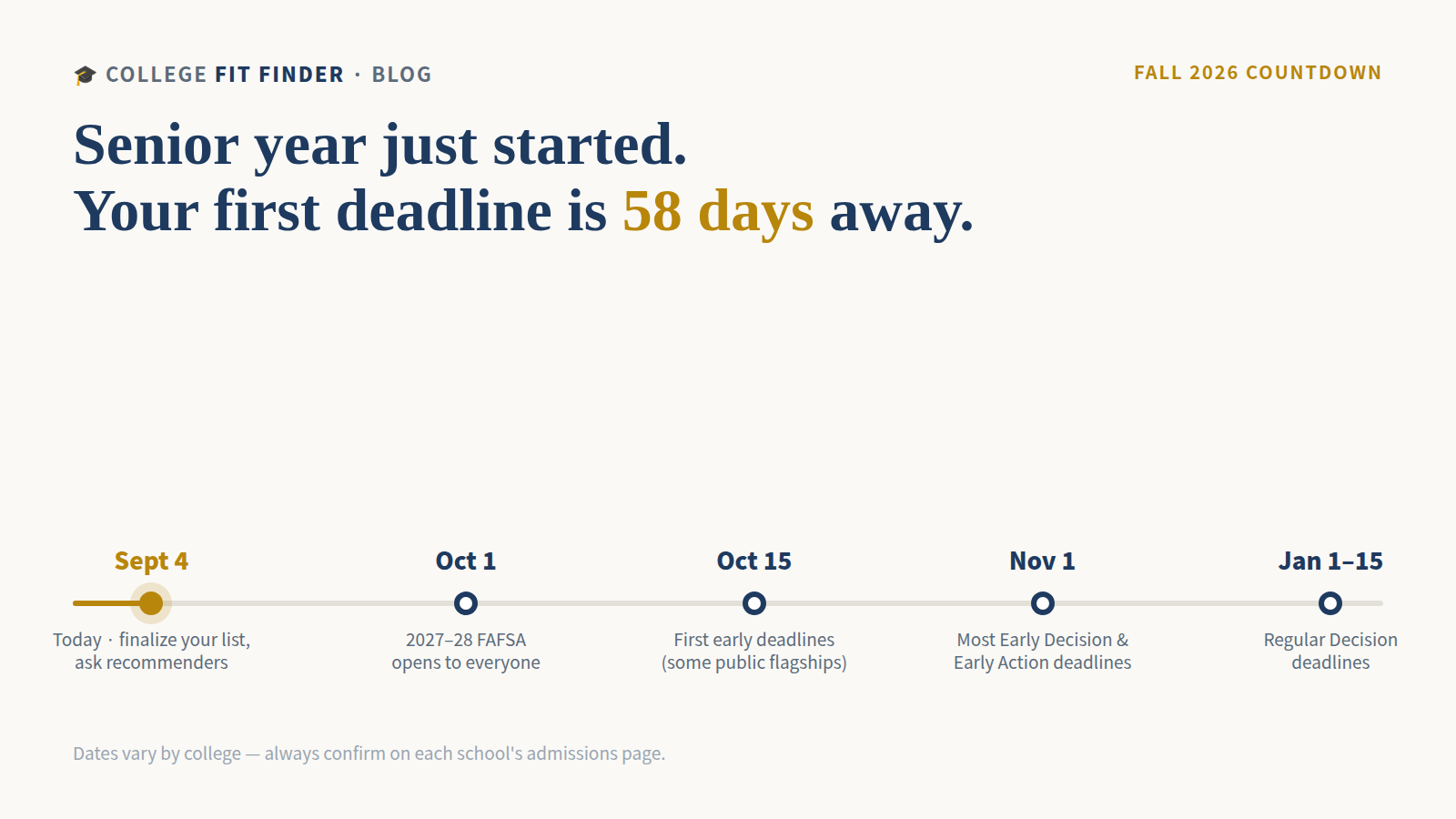
Senior year is about a week old, which means the most important stretch of the college search starts now. Most Early Decision and Early Action deadlines fall on November 1 — 58 days from today. The 2027–28 FAFSA opens to everyone on October 1. And a handful of public flagships want early applications by October 15.
None of that is a reason to panic. It is a reason to use September well. Here's the checklist we'd hand a senior this week.
1. Lock the list — and make sure it's balanced
By mid-September, your list should be close to final: roughly 2–3 schools you're very likely to get into, 3–4 targets, and 2–3 reaches. If every school on the list is a reach, it isn't a list; it's a lottery ticket.
Balance isn't just about admission odds. Run the net price calculator on every school's financial aid page and make sure at least a couple of your likely schools are also affordable. A school you can get into but can't pay for isn't a safety.
2. Ask your recommenders this week — not in October
Teachers get buried in recommendation requests in October. Ask now, in person if you can, and give each one a short "brag sheet": the classes you took with them, a project you're proud of, what you're planning to study, and the deadlines they're writing for. Then make sure they're invited through the Common App or your school's system so the forms are ready when they are.
3. Get FAFSA-ready before October 1
The Department of Education has certified that the 2027–28 FAFSA will launch by October 1, and it's already in a second round of beta testing. Between now and then:
- Create a StudentAid.gov account for the student and each contributing parent. Do this now; ID verification can take a few days.
- Gather 2025 tax returns and current bank statements. The form pulls tax data automatically once you consent, but you'll still want the paperwork handy.
- Check whether your schools also require the CSS Profile (many private colleges do). It opens October 1 too, and it's a separate form.
File as close to October 1 as you can. Some state and institutional aid is first-come, first-served.
4. Decide — carefully — whether to apply early
This is the decision that trips up the most families, because the three "early" plans sound alike and aren't.
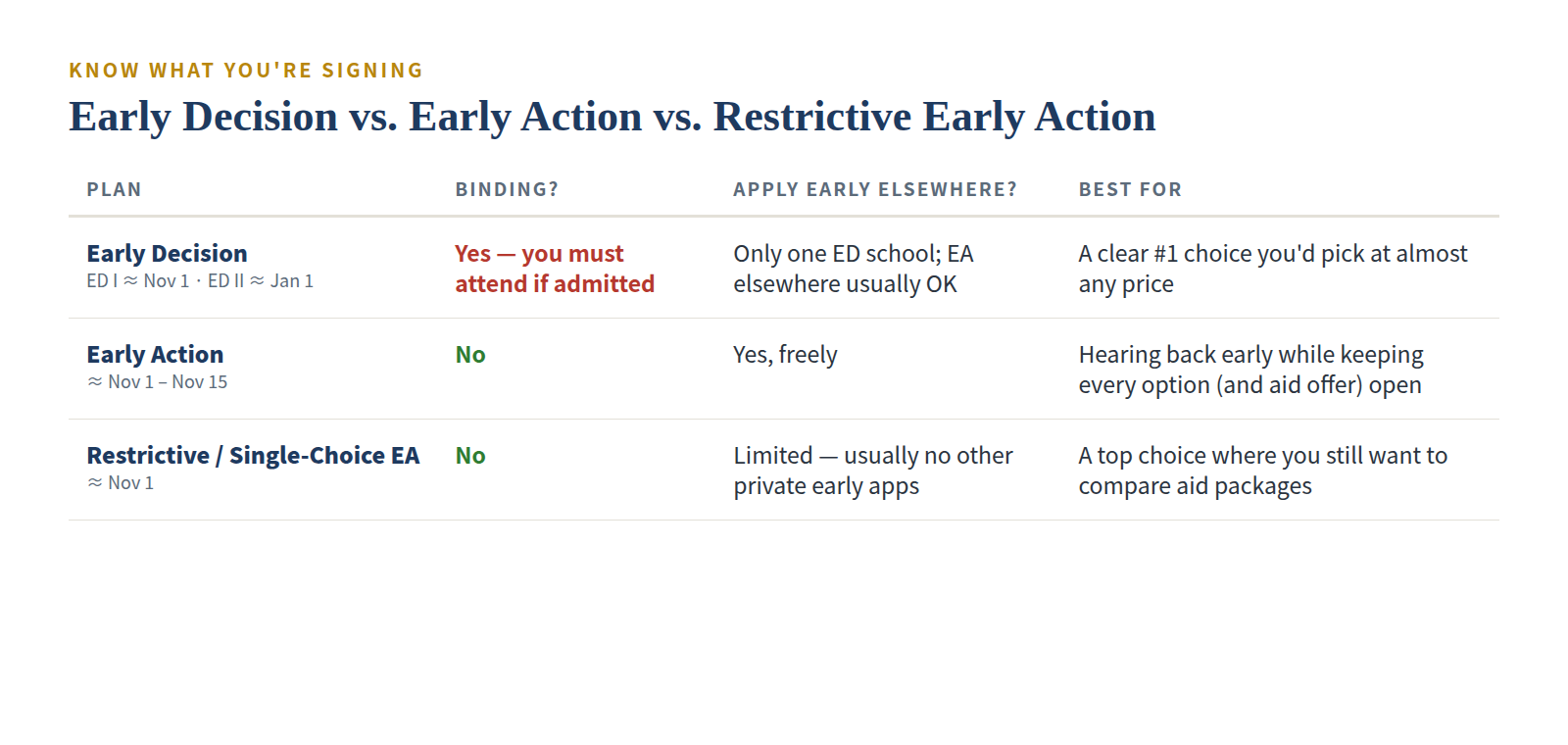
- Early Decision (ED) is binding. If you're admitted, you withdraw every other application and attend. Apply ED only to a clear first choice — and only if the net price calculator says you can afford it. Many schools also offer an ED II round in early January.
- Early Action (EA) is not binding. You hear back early, usually by mid-December, and keep every option — and every aid offer — open until May 1. If a school offers EA, there's rarely a downside.
- Restrictive or Single-Choice Early Action isn't binding either, but it usually bars you from applying early to other private colleges. Read each school's rules; they differ.
The one rule we'd underline: don't apply ED anywhere you haven't run the numbers. Backing out of a binding offer over cost is possible but messy, and it's completely avoidable.
5. Draft the essay now, polish it in October
The personal statement should be in draft by the end of September so October is for revising, not starting. Write about something only you could write. Then read it aloud — if it sounds like a college essay, cut the part that sounds like a college essay.
6. Put every date on one calendar
Deadlines, test dates, recommender due dates, FAFSA, CSS Profile, scholarship applications. One shared calendar, visible to the student and a parent. Most senior-year disasters aren't about ability; they're about a date nobody wrote down.
What to watch next
We'll cover the FAFSA launch when it happens on October 1, including what changed on this year's form. Between now and then: finish the list, ask the recommenders, and make the ED decision with a calculator in hand.
Sources: U.S. Department of Education / Federal Student Aid; National Association of Student Financial Aid Administrators (NASFAA); U.S. News & World Report; Common App.